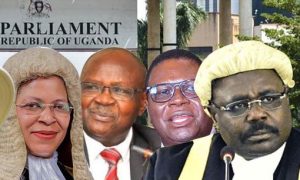
As political focus shifts toward Kyankwanzi, a fresh wave of speculation is rippling through Uganda’s political circles, centering on the future of Anita Annet Among.
Insiders suggest that her position could be among the final high-level decisions shaped during the ruling party’s ongoing strategic retreat, an event long associated with pivotal shifts in the country’s leadership structure.
Among, who currently serves as Speaker of Parliament, occupies one of the most powerful offices in Uganda’s governance framework. From presiding over legislative proceedings to influencing the tone and direction of national debate, her role places her firmly at the heart of state power.

Yet, as with many senior positions within the system, her political trajectory remains closely intertwined with internal dynamics within the National Resistance Movement and the broader calculations of President Yoweri Museveni.
According to ongoing political speculation, Among could be redeployed to the position of Vice President as part of a wider restructuring of power within the establishment. Such a move would not necessarily signal a decline in influence.

Rather, analysts view it as a calculated redistribution of authority—one that would keep her within the upper echelons of leadership while potentially easing her direct control over parliamentary processes.
At the same time, attention has turned to the presence of Norbert Mao at Kyankwanzi, raising questions about his role in the evolving political equation. His invitation has fueled debate about whether he could be considered for a more central institutional position, including the Speakership. Observers note that elevating Mao could serve as a strategic attempt to broaden political alliances, leveraging his background and connections beyond the ruling party while projecting an image of inclusivity within government ranks.
This pattern of strategic recalibration is far from unprecedented. Kyankwanzi has, over the years, developed a reputation as a crucible for major political decisions. Perhaps the most cited example remains the dramatic shift involving Amama Mbabazi. Once a dominant figure as both Prime Minister and Secretary General of the NRM, Mbabazi’s political fortunes changed sharply following the 2014 Kyankwanzi retreat. During that gathering, party leaders endorsed Museveni as the sole candidate for the 2016 elections, effectively sidelining internal challengers.
The consequences unfolded quickly. Mbabazi was subsequently removed from key party and government roles and later broke ranks to contest against Museveni in the 2016 presidential election. That episode cemented Kyankwanzi’s status as a center of political consolidation, where loyalty is tested and the balance of power is often decisively reconfigured.
It is against this historical backdrop that current developments are being interpreted. Political observers point to a recurring strategy: managing influence carefully, preventing the over-concentration of power in any single office, and relying on redeployment rather than outright dismissal to preserve cohesion within the ruling structure.

Additional remarks by Ofwono Opondo have further underscored the inclusive nature of Kyankwanzi engagements. He has highlighted that participation in such retreats is not limited strictly to core NRM figures. Leaders from across the political spectrum—including ministers, independents, and other aligned actors—often take part, reinforcing the notion that Kyankwanzi functions as a broader platform for political alignment rather than exclusion.
Should current speculation materialize, analysts suggest the process would likely follow a familiar sequence. A high-level retreat sets the tone, leadership emphasizes unity and coalition-building, and key figures are reassigned in line with shifting priorities. Under such a scenario, Among could transition to the Vice Presidency, while a figure like Mao might emerge as a consensus candidate for Speaker.
Even so, constitutional realities remain a critical factor. The Speaker of Parliament is elected by Members of Parliament rather than directly appointed, meaning any transition would require careful political coordination and the backing of a parliamentary majority.
For now, these developments remain within the realm of speculation. Yet the signals emerging from Kyankwanzi once again highlight its enduring role as a निर्णસive arena in Uganda’s political landscape—where careers are recalibrated, alliances quietly negotiated, and the future direction of leadership often determined behind closed doors.